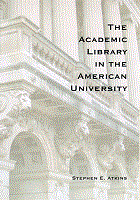
 “Throughout the history of American higher education, the academic library has supported the university in its academic mission,” Dr Stephen E. Atkins writes in The Academic Library in the American University. Noting its evolution over three-and-a-half centuries, the former president of the American Library Association continues, “The academic library has become a depository of materials that support faculty and graduate student research in an almost infinite variety of disciplines.” For my part, I shall be forever grateful to the academic libraries of Brazil for that is where I found my beloved wife, a reference librarian in the humanities.
Monday, September 30, 2013
It's Academic
“Throughout the history of American higher education, the academic library has supported the university in its academic mission,” Dr Stephen E. Atkins writes in The Academic Library in the American University. Noting its evolution over three-and-a-half centuries, the former president of the American Library Association continues, “The academic library has become a depository of materials that support faculty and graduate student research in an almost infinite variety of disciplines.” For my part, I shall be forever grateful to the academic libraries of Brazil for that is where I found my beloved wife, a reference librarian in the humanities.


Friday, September 06, 2013
The Mass Grave of Reflection
Whether it is through the ascending drumbeats for war or the steady drone of mindless advertisements, the empty slogans that assail our senses are constant reminders that we live in a time when critical thinking was never more needed or practised less often. As Carl Jung observes in The Undiscovered Self, “The mass crushes out the insight and reflection still possible with the individual, and this necessarily leads to a doctrinaire and authoritarian tyranny if ever the constitutional State should succumb to a fit of weakness.” The day America´s Constitution dies, her once noble experiment as a democratic republic dies with it. Sic transit gloria Americae.
Wednesday, August 28, 2013
Practically Abandoned by One’s Friends

Whence, where, and why the English major? Adam Gopnik asks in the New Yorker, noting its impending demise like the Latin prerequisite before it ― “a dying choice
bound to a dead subject.” Despite his sympathies, Gopnik finds the apologias of
the discipline's defenders unpersuasive, mocking “The Economic Case for Saving the Humanities” proffered by Brown University’s Christina Paxson as “the kind of Letter to a Crazy Republican Congressman that
university presidents get to write.” Like most pragmatic parries, it
surrenders the tradition’s essence in the vain hope its accidents might carry
the day or, at least, prolong the inevitable. Hardly surprising, given the bottom line for Paxson’s fellow economists: “Is it worth
it?” ― not the best way to defend the intrinsic worth of the humanities, even
in an age that abhors such “useless knowledge.”
Wednesday, August 21, 2013
Buzzwords Drone On

Monday, August 19, 2013
Dead to the World Around Them
 When I was as young as the lad to our left, I walked the streets of Olneyville, my nose buried in a book, oblivious to all but the occasional blare of horns waking me from my contemplation. Today, as Wayne Curtis writes in The Smart Set, the eyes of digital zombies are fixed on screens, not paper pages, but the risks of collateral damage remain the same. "From time to time, they will glance up and a brief squall of confusion will cross their faces as they try to reorient themselves. ... They wander into streets and traffic as if no cars or other hazards exist in their parallel universe." The hazards of substituting texting for reading ― or conversation, for that matter ― is a subject for another time.
Monday, August 05, 2013
Building Blocks of English: Affixes

Friday, August 02, 2013
A Literary Triple Play
 In the fall of 1874, William Dean Howells, editor of the Atlantic Monthly, importuned Mark Twain for something to put in its columns for the coming year. Twain at first demurred; then passed on the suggestion of his closest friend, the Reverend Joseph Hopkins Twitchell, to write about Clemens' piloting career on the Mississippi river. The result, as they say, is history. As John T. Flanagan wrote for Minnesota History in 1936, "It is interesting to note that neither the conception of nor the early stimulus for one of Mark Twain's greatest books was original with the author." Mark Twain on the Upper Mississippi Cf. The Lincoln of Literature: Mark Twain, The Atlantic, and the Making of the Middlebrow Magazine
Thursday, May 23, 2013
Laughing at our Losses
 As Prof. Michael Saler observes in a recent book review, Silicon Valley is the seedbed of a 21st-century ideology that's more readily mocked than negated. In To Save Everything, Click Here, Evgeny Morozov, dubbed by Saler today's H.L.Mencken, punctures the cyber-sect's banal platitudes in the most hard-hitting and sardonic critique published to date.
Laughter is often the last freedom of the vanquished, but considering the stakes at hand, it is no time for defeatism for defenders of a more human and humane culture. As a college basketball coach might urge his players, read and react!
Saturday, May 18, 2013
Rolling the Dice on Artificial Intelligence
 In 2009, Henry Markram boldly proposed to create a computer replica of the human brain within a decade. Fellow neuroscientist Haim Sompolinsky at Hebrew University of Jerusalem calls the idea a fantasy. Will Markram succeed in replicating human consciousness, a challenge that has stymied researchers in Artificial Intelligence? At a time when austerity is being imposed at dire human cost across Europe, the European Union is betting $1.3 billion on it, while the United States contemplates it own multibillion-dollar project.
Thursday, May 16, 2013
Lethal Loneliness

Tuesday, April 09, 2013
Celebrating a Half Century of Excellence

"If anything, it was an intellectual community. It was people we knew and admired: a community of writers we knew but who hadn't come together in that way before, except for some of the critics who wrote for the Partisan Review. It was determined by friendships, by a shared belief in uncompromising quality in writing, and by a sense that much conventional criticism was superficial and lazy, accepting the mediocre." Robert Silvers, founding editor of the New York Review of Books, discusses its history as we celebrate its 50th anniversary. See Mark Danner's interview in New York for additional insights.
Tuesday, March 19, 2013
Farmers Market to Mens Department?

Subscribe to:
Posts (Atom)